Mounting Sources of Discontent: Inequality, democratic decline and militarisation
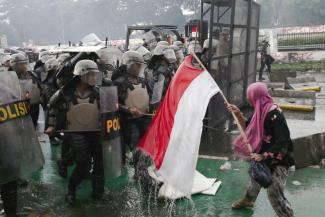
Since protests across Indonesia in late-August and early-September 2025, authorities have pursued thousands of alleged participants, keeping hundreds in prolonged detention, often without sufficient evidence. The sources of protestors’ discontent include inequality and unemployment but also a declining quality of democracy. Another source of dismay is President Prabowo Subianto’s militarisation of civilian institutions.

Torture in Detention in West Papua: Impunity, Secrecy and Silence
Our new briefing highlights the epidemic of torture by the police and the military in West Papua and impunity for these crimes.

More than putting the Government’s house in (a new) order: Prabowo’s programme of militarisation takes shape
President Prabowo Subianto’s plans for extensive militarisation of the Indonesian Government were already clear when he was Minister of Defence, marked by massive increases in arms and equipment procurement which have continued. This was accompanied by the insertion of military officers into the civilian bureaucracy and the signing of Memoranda of Understanding (MoUs) under President Joko Widodo.

Prabowo: 100 days of Militarism, Agriculture, and Amnesties
In his first 100 days of office, President Prabowo Subianto has appointed several military figures to his Cabinet, including serving officers. Senior figures have proposed reforming the military law, allowing the military to hold business interests and more serving officers to work in civilian government posts. Military businesses are already a driver of conflict in resource-rich areas, above all in West Papua.Prabowo has also promised to pursue food self-sufficiency through ‘Food Estates’. But in West Papua, many Food Estates have already been earmarked for growing export crops.Thirdly,...

Maybrat: Return of Displaced People Fails, Injustices Continue
This briefing provides an update on the situation in Maybrat Regency, which we first reported on in February 2022. In September 2021, security forces initiated operations in response to an attack on a new military post in Maybrat.
Human Rights Court Mechanism and The 2014 Paniai Papua Case
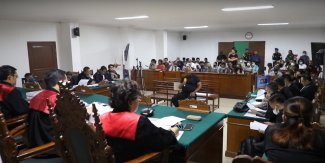
In this briefing, AJAR (Asia Justice and Rights), KontraS (the Commission for the Disappeared and Victims of Violence) and TAPOL, members of the Coalition of Civil Society for Monitoring of the 2014 Paniai Case which also consists of a number of human rights organizations in Papua, Indonesia and internationally, explain how Indonesia's Human Rights Court mechanism works and its past record.

Illegal arms sales, internal displacement and a ‘new approach’ in West Papua
This briefing looks at reports of illegal sales of weaponry by the security forces, continuing internal displacement and the military's claimed new approach. It looks especially at the reasons behind these developments, and the lack of coherent action on the part of the Government.

Militarisation, Conflict and Injustice in Maybrat Regency, West Papua
Following a period of military expansion in the region, Maybrat has been the scene of violence between the military and West Papua’s pro-independence armed group, TPNPB (Tentara Pembebasan Nasional Papua Barat, the National Liberation Army of West Papua). This briefing shows drivers of recent conflict in Maybrat, especially militarisation and natural resource contestation.

The Indonesian military and counter-terrorism: new business, same old ways
From the early 2000s, terrorism in Indonesia was regarded as a matter of ‘security and order’, and dealt with by the police and its militarized anti-terror unit, Densus 88. However, in 2018, legislation was amended which marked a shift in that the Indonesian military was again given a key role in countering terrorism. In 2021, this legal provision was brought into play as the main West Papuan armed resistance, the TPNPB was designated as a ‘terrorist’ organisation by the Government.

Special autonomy – big on funds, short on human rights and democracy
In this briefing we describe how the law has failed to achieve its objectives in two ways. First, despite promising to ‘protect’ West Papuan culture, and to economically empower indigenous West Papuans, many important aspects of the law have been only partly implemented or ignored altogether. Second, instead of implementing the law, the authorities have resorted to governing through a programme of development projects from abundant funds.
Entrenched militarism, the ‘prosperity’ approach and governance by exception in West Papua
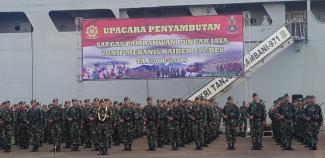
Since the fall of the New Order regime (1966-1998), with one brief period of exception between 1998-2001, the power and authority of the Indonesian security forces in the region of West Papua have remained largely undiminished. We attribute this to two reasons, both of which stem from a failure to implement genuine political reform in West Papua and Indonesia more broadly.
Indonesia: The New Omnibus Law
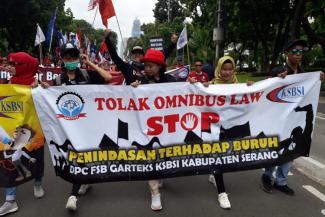
The draft law remains the subject of extensive street protests across Indonesia. This was met with a significant security force crackdown in response, including violence committed against demonstrators - labour and environmental activists and students - while making arrests.
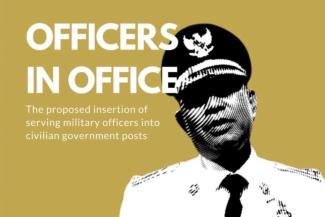
Indonesia: Officers in Office
It has been more than two decades since a process of democratic reform was initiated in Indonesia under which the military stepped back from its political role. As part of the reforms, the military were gradually removed both from legislative posts that guaranteed it political representation and also posts in Indonesia’s civilian bureaucracy.

Submission to Universal Periodic Review of Indonesia, third cycle (27th session)
The joint submission by TAPOL and BUK provided information on human rights in Indonesia to the Human Rights Council Universal Periodic Review in April 2017. The submission focuses on human rights issues in Papua, with a particular focus on ensuring freedom of expression in West Papua. To read the full submission please download the PDF.
Urgent Appeal - Indonesia: Killings, torture, mass arrests and excessive use of force against Papuans commemorating 1 December
Mr Maina KiaiUN Special Rapporteur on Freedom of Assembly Mr David KayeUN Special Rapporteur on Freedom of Expressioncc. Mr Zeid Ra'ad Al Hussein, UN High Commissioner for Human Rights Mr Juan Mendez, UN Special Rapporteur on torture and other cruel, degrading or inhuman treatment or punishment Ms. Victoria Tauli-Corpuz, UN Special Rapporteur on Indigenous Peoples Mr. Christof Heyns, UN Special Rapporteur on Extrajudicial, Summary or Arbitrary Executions Mr. Laurent Meillan, Deputy Head, OHCHR Regional Office for South East...
TAPOL calls for action on Bloody Yotefa case
Following a civil society investigation into the Bloody Yotefa case on 2 July 2014, today TAPOL called on the UN Special Procedures to intervene to ensure an independent investigation, safety of the surviving victims, justice and the right to remedy for the victims. During the incident, which occured following the death of a police officer in Yotefa Market, Abepura police carried out sweeping raids which resulted in the torture of four indigenous farmers by police and by migrant mobs with state-sanctioned complicity, as well as the arbitrary arrests and detention of forty people. While the...
UA: Arbitrary arrests, torture and killings following violence at Yotefa Market
Dear Mr MendezIndonesia: Arbitrary arrests, torture and killings following violence at Yotefa Market, AbepuraWe are writing to you on behalf of TAPOL regarding a violent incident which occurred on 2 July 2014 at Yotefa Market in Abepura, Papua, Indonesia, after a policeman was killed while attempting to break up a dice game. Police conducted a sweep of the area making 40 arbitrary arrests, opening fire on a public bus and its passengers and torturing four men. During the police sweeping three students were killed in different locations near the market place by unknown masked assailants. All...
Urgent Appeal: Stop criminal proceedings against Papuan human rights lawyer
The International Coalition for Papua (ICP) and TAPOL are writing to inform you of a case concerning the criminal investigation initiated by Papua Regional Police against prominent Papuan human rights lawyer, Gustaf Kawer. He has received two summonses under accusations of coercion and rebelliousness under Articles 211 and 212 of the Indonesian Penal Code.The criminal investigation against Mr. Kawer is based on a report filed by an administrative court judge who examined an indigenous land dispute in which Mr. Kawer’s client is a party. In a hearing held on June 12, 2014, Mr. Kawer protested...
Urgent Appeal: 2 Papuans arrested & tortured for calling for release of political prisoners
Urgent Appeal Dear Mr La RueIndonesia: Two Papuan students arrested and tortured for calling for the release of political prisonersWe are writing to you on behalf of TAPOL and the undersigned organisations regarding the violent dispersal of a demonstration in Jayapura, Papua, on 2 April 2014, and the arrest and torture of two students, Alfares Kapisa and Yali Wenda. While the students have now been released, we believe that police conduct violated the fundamental rights to freedom of expression and assembly, the right to freedom from torture, the UN Basic Principles on the Role of Lawyers and...
Urgent Appeal to Special Rapporteur on EJs: West Papuan activist poisoned to death
20 December 2013
Mr. Christof Heyns
UN Special Rapporteur on
extrajudicial, summary or arbitrary executions
c/o OHCHR-UNOG
1211 Geneva 10
SWITZERLAND Fax: +41 22 917 9006Dear Mr. Heyns,Re: Letter of allegation – West Papuan activist poisoned to deathHuman Rights and Peace for Papua (ICP), Fransiscans International, TAPOL, the West Papua Netzwerk (WPN) and the Asian Human Rights Commission (AHRC) are writing to inform you of a case regarding the suspicious death of Danny Kogoya, the Jayapura regional commander of the Free Papua Movement (Operasi Papua...